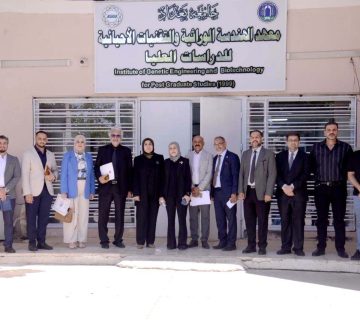

During her appearance on “Shatharat”…
— The first female student at the Institute of Genetic Engineering talks about her academic journey
— What is the “one word” she addressed to students? And what is the secret behind her passion for literature, cooking, and volunteer work?
Prepared and interviewed by: Asst. Lecturer Rand Qusay Majeed
Edited by: Ahmed Mohammed Zmeem
Filming: Ma’an Rabee Abbas
Supervised by: Dr. Rami Ali Taqi
Dr. Ashwaq Basim is a person with her own unique interests. She is passionate about fields far from her scientific specialization, such as literature, art, cooking, and volunteer work. At the same time, she is a leader and an inspiration who shares her experiences beyond the laboratory through guidance, student support, and community engagement. She is a woman who faces daily challenges and balances life, ambition, rest, success, and pressure.
Today, she is the guest of “Shatharat” from the Institute of Genetic Engineering, with our colleague Assistant Lecturer Rand Qusay Majeed.
— How would you describe your journey?
The path was not straight; it was full of silent exhaustion. At every stage of my life, I learned that strength is not noise, but persistence. A PhD did not change me—it revealed that I have always been capable, by God’s will, of continuing and achieving my dreams.
— Why did you choose genetic engineering?
I chose genetic engineering because it gives me the opportunity to make a real difference in people’s lives by understanding the precise mechanisms of genes and contributing through my research to treating genetic diseases and improving human health.
— How do you balance your personal life and work?
Balance does not mean equal division every day. Rather, it means feeling present in your life just as you are present in your work. It is a conscious balance between core skills and precise laboratory skills—such as handling samples, using modern tools and techniques, scientific analysis and reasoning, interpreting results, solving technical problems, as well as accuracy, patience, scientific communication, and teamwork.
— What research field in biotechnology do you see as most promising?
Biotechnology is a bridge between scientific research and real life, and it represents a revolutionary future in medicine and agriculture.
— How do you evaluate the level of scientific research in Iraq compared to other countries?
Iraq has excellent human potential, and its scientific level benefits from talented researchers. However, it needs greater support in laboratory funding and infrastructure to reach the level of developed countries.
— How did the Institute of Genetic Engineering contribute to developing your skills?
It played a major role in refining my scientific skills. Among the most important skills I gained in the lab are handling samples, applying genetic engineering techniques, reading and interpreting results scientifically, and managing research projects.
— Have you received any awards or recognitions?
Yes, I received the award for Best Graduate Student for excellence in publishing international research, as well as many official letters of appreciation from the Prime Minister and the institute’s administration. My scientific participation also helped me exchange expertise with researchers and expand my global academic network.
— What does it mean to be the first female student in the institute among the first cohort accepted into the Master’s program in 1999?
Being the first graduate from the institute is more than just a title—it is leadership and responsibility. Being first means paving the way for the students who come after me, creating new methods and solutions instead of relying on previous experience. In doing so, I created a small piece of history for myself and opened the door for others to continue the journey.
— What advice would you give to students?
Patience and discipline are the keys to academic and research excellence.
— Who has had the greatest influence on your life, especially academically?
Success is usually the result of collective support, not individual effort. First comes my family, by God’s grace—my father, mother, brothers, and sisters. I also cannot forget my professor, especially my supervisor Dr. Amina Neama Al-Thuwaini, who had a significant impact on my academic life, as well as my colleagues and friends who have all been a great support.